
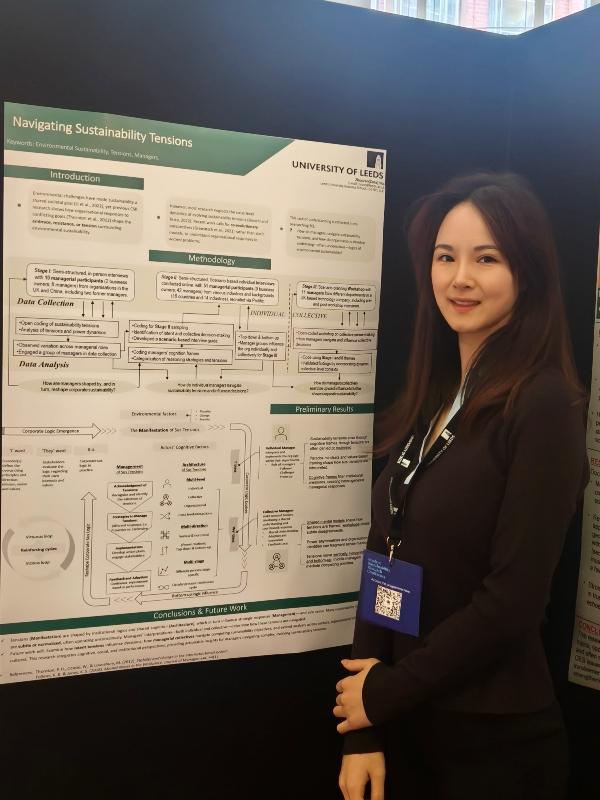
Abstract
Organisations face persistent sustainability tensions as they navigate competing economic, social, and environmental logics. Focusing on the environmental dimension, this study examines how individual sensemaking is embedded within collective managerial interpretations of sustainability logics, which often overlooked in prior research. It explores how managers navigate these tensions at individual and collective levels, highlighting the recursive dynamics through which sensemaking shapes, stabilises, and reconfigures environmental sustainability logics in practice.
Drawing on a systematic review of 262 scholarly articles and 17 grey literature sources, the study develops an integrative framework that conceptualises sustainability tensions across three interrelated dimensions: Manifestation (how tensions emerge and are perceived), Architecture (how they are structured across organisational levels), and Management (how organisations respond strategically over time).
Building on this framework, the study reports preliminary findings from an ongoing inductive qualitative project. The research draws on a multi-source dataset, including 71 in-depth interviews, a scenario-based workshop, ranking and decision tasks, and field observations collected over 11 months. Early analysis reveals that managers often downplay or deny sustainability tensions, framing environmental priorities as aligned, routinised, or resolved. Tensions emerge implicitly through decision rationales, prioritisation exercises, and collective sensemaking processes.
These findings challenge dominant assumptions that sustainability tensions are always salient or consciously experienced. They foreground managerial collective cognition as a critical mechanism shaping whether tensions are recognised, muted, or strategically mobilised, advancing a dynamic, multi-level understanding of sustainability tensions within organisations.